Kintsugi and Wabi-Sabi: Finding Beauty in Breakage
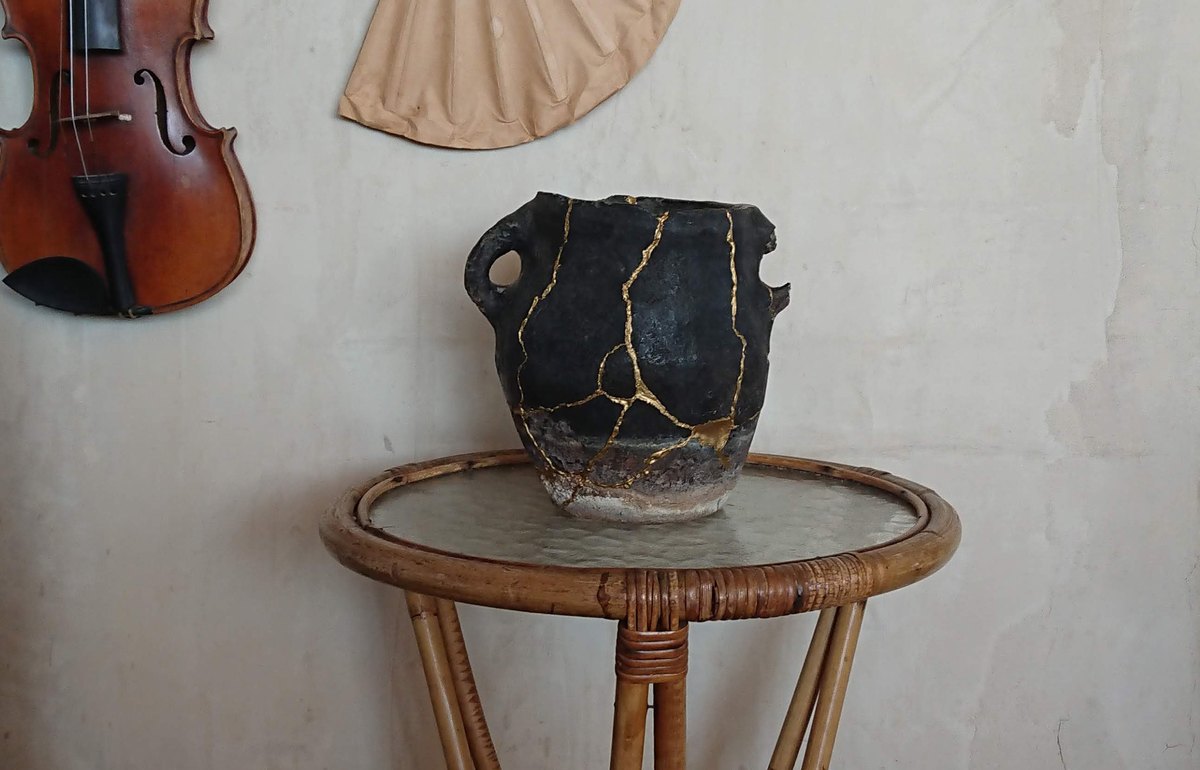
When a cherished bowl breaks, the usual instinct is to hide the damage or replace the object. Kintsugi proposes another possibility. Instead of pretending that the break never happened, it makes the repair visible—often as a delicate line of gold across the ceramic surface.
That visible line is why kintsugi is so often linked with wabi-sabi, the Japanese aesthetic sensibility that finds value in imperfection, simplicity, and transience. Yet the connection is richer than an image of “beautiful flaws.” Kintsugi is first a demanding material practice of repair. Its beauty comes from attention to an object’s history, its maker, and the care required to bring it forward responsibly.
A Break Becomes Part of the Story
The Japanese word kintsugi is commonly translated as “golden joinery.” It refers to a method of repairing broken ceramics in which joins and areas of loss are made visible with lacquer and metallic powder. The New Orleans Museum of Art describes the approach as one that treats cracks as part of an object’s beauty and history rather than something to disguise.[1]
The well-known story connecting the technique to the fifteenth-century shogun Ashikaga Yoshimasa is best understood as an origin story: after a favored tea bowl was repaired with metal staples, craftsmen were said to have sought a more aesthetically satisfying solution. Whether encountered as history, legend, or both, the story points to a lasting principle. Repair is not always an attempt to erase what happened. It can acknowledge loss while making continued use possible.

Wabi-Sabi Is Not a Permission to Neglect
Wabi-sabi is often reduced to a slogan about loving imperfections. That shortcut misses its quiet discipline. The sensibility asks us to notice the character of materials, the passage of time, and the dignity of what is unforced. A repaired object may embody those values—but only when the repair respects the object rather than turning damage into decoration.
NOMA calls kintsugi a tangible display of wabi-sabi’s appreciation of imperfection, simplicity, and transience.[1] It is a helpful connection, provided we do not collapse the two ideas into one. Wabi-sabi is a broad aesthetic orientation; kintsugi is a specific craft practice. A golden seam can be striking, but its significance lies in the patient work beneath the surface: aligning fragments, filling loss, allowing materials to cure, and returning attention to a vessel that might otherwise be discarded.
The result is not an untouched object. Nor should it be. It is an object with a new surface, a changed balance, and an honestly visible history.
The Quiet Labor Behind the Gold
Gold is the most visible part of kintsugi, but it is not the whole story. The Smithsonian Center for Folklife and Cultural Heritage notes that traditional kintsugi uses urushi, a natural lacquer, with pure gold powder, and that a project can take as long as three months.[2] The repair is therefore a practice of time as much as of appearance.
Urushi also deserves respect as a material. The Smithsonian notes that wet lacquer can irritate the skin, even though it is harmless once dry.[2] This is one reason that the romance of gold lines should not be confused with a casual home project. A meaningful repair has technical, practical, and sometimes food-contact questions that depend on the vessel and the chosen method.

Choosing Repair With Care
Not every break calls for kintsugi. A repair may be appropriate when an object has personal meaning, when its fragments are sufficiently intact, and when the completed vessel can be used or displayed safely. But some pieces are better retired, preserved as they are, or assessed by a professional. The responsible question is not “Can this be made gold?” but “What does this object need now?”
| Consideration | Why it matters |
|---|---|
| Meaning | Kintsugi is most compelling when it responds to an object worth keeping, not an abstract ideal of imperfection. |
| Condition | Missing fragments, unstable cracks, and the intended use of the vessel affect whether repair is realistic or appropriate. |
| Method | Traditional urushi work, simplified workshop methods, and professional conservation serve different purposes and should not be treated as interchangeable. |
Los Angeles County Museum of Art’s conservators make this distinction clearly. They study and practice kintsugi as an important traditional method, yet do not use it for most museum treatments because it is not always appropriate; conservation treatment generally prioritizes reversibility and the original intent of the object.[3] That perspective is useful at home, too. Reverence for repair includes knowing when to seek specialist advice.
A New Life for a Familiar Vessel
For a handmade piece such as Suzu-yaki, a break can feel especially personal. Its dark clay, ash-kissed surface, and quiet irregularity make each vessel distinct before anything happens to it. If a cherished Suzu-yaki piece breaks, do not assume that it must be repaired—or that it must be returned to daily food use. Consider the maker’s guidance and, for a valued vessel, consult an experienced restorer or kintsugi practitioner.
When repair is the right choice, kintsugi can create a new keshiki, or landscape, across the surface. The join does not reproduce the old bowl. It makes a different one: a vessel whose line of gold records care, restraint, and the decision not to abandon a meaningful object too quickly.

Beauty That Does Not Rush
Kintsugi and wabi-sabi meet in their refusal to demand perfection from the things we live with. Neither asks us to celebrate every accident. Instead, they invite a more deliberate response: see the object clearly, honor the work it took to make it, and decide what kind of future it can honestly have.
In that sense, a golden seam is not a shortcut to meaning. It is the visible edge of patience. The beauty is not in breakage alone; it is in the care that follows.
Sources
Related reading: For a careful connection between ceramic repair, continued use, and contemporary sustainability, read Kintsugi and Sustainability.