Agehama salt is Noto salt made with seawater, packed sand, sun, muscle, and fire. Along the northern coast of Ishikawa, the traditional method turns a broad seascape into a small, concentrated ingredient. It is not an industrial shortcut. It is a seasonal craft in which water is carried, sprayed, raked, gathered, and boiled until the sea becomes crystals.

What “Agehama” means in practice
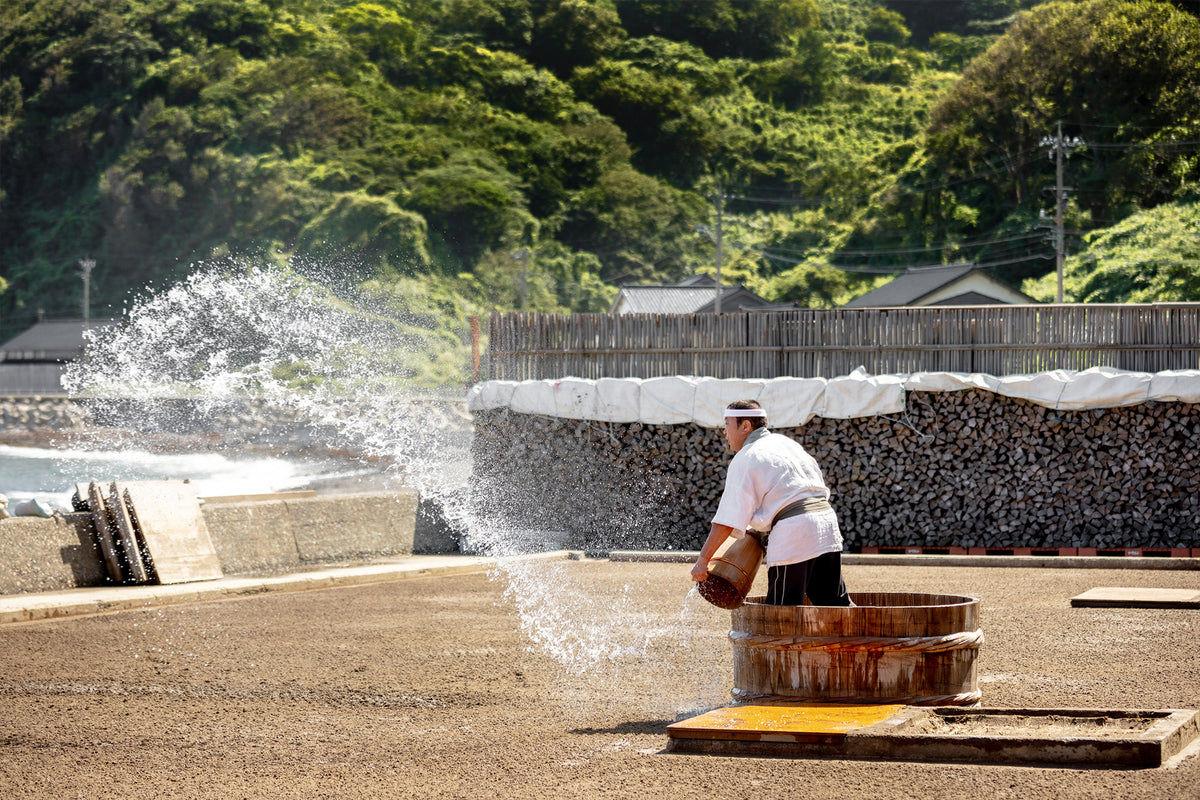
Agehama (揚げ浜) is the name commonly used for this traditional salt-making method in Oku-Noto. Ishikawa Travel describes a process that begins with seawater carried to a prepared sand field. Workers spray the water across the packed surface with a conical bucket, then rake the sand as the water evaporates. Salt crystals remain attached to the sand; the concentrated material is collected and washed with seawater to create brine before the final boiling stage.
The process is repetitive by design. The sea is not simply poured into a pan and left alone. The salt field increases the seawater’s concentration first, while the rake and the sun do part of the work. The brine is then boiled in large cauldrons for many hours. Japan Up Close describes a boiling stage of about twenty hours or more; the Okunoto visitor information describes about eighteen hours. Exact times vary by operation and conditions, but the principle is consistent: patient reduction creates the finished salt.
A craft shaped by Noto’s coast
Noto’s geography helps explain why the tradition endured. The peninsula has a long, irregular coastline and communities historically accustomed to making a living from both land and sea. Japan National Tourism Organization describes salt harvesting in Oku-Noto as a roughly five-hundred-year practice. The work belongs to a wider local culture in which weather, shoreline, fields, forests, and household labour are closely connected.
That relationship is often described through satoumi, the human-shaped coastal landscape, alongside satoyama, the managed rural landscape inland. These are not decorative labels for scenery. They point to the practical systems that make a place inhabitable: collecting, tending, carrying, preserving, and passing on knowledge. Read Noto’s Satoyama and Satoumi for wider context.
Why the method demands skill
Agehama looks simple from a distance—a person, a field, a bucket, the sea—but the timing is exact. Too little spray and the sand will not concentrate enough salt. Too much, or the wrong weather, and evaporation slows. The work is physically demanding, and the official Ishikawa account notes that masters train for years: three years in gathering seawater and ten years in spraying it over the sand.
This is a useful corrective to the idea that “handmade” means merely small-batch or rustic. A hand process can contain a large body of technique. The maker’s judgement is present in the movement of the bucket, the condition of the field, the timing of the rake, and the decision to move from brine to pan. Tradition is not the absence of technology; it is the careful retention of knowledge that still has a job to do.
Sea salt and Suzu-yaki: the same landscape, different crafts
Agehama salt is not an ingredient in Suzu-yaki, and the two crafts should not be blended into one story. Their connection is geographical and elemental. Both belong to Noto; both ask people to work with local material rather than conceal it; and both make time visible. Salt concentrates seawater through sun and fire. Suzu-yaki turns iron-rich clay into dark, unglazed stoneware through reduction firing.
That is why a small Suzu-yaki object can carry a sense of place without becoming a souvenir replica. It is a useful vessel made by a living maker. Explore What Is Suzu-yaki?, or follow the coastline through The Okunoto Salt Road.
A taste of Noto’s slower rhythm
Traditional Agehama salt is often described as having a mild, rounded sea flavour. It is best understood at the table, used with enough restraint to notice what it brings to rice, vegetables, or a simple broth. The point is not to turn a regional ingredient into a health claim or a luxury slogan. The point is to recognise the labour held in a pinch: shoreline water, worked sand, long heat, and the accumulated judgement of people who know the process.

Bring a piece of Noto’s craft landscape home
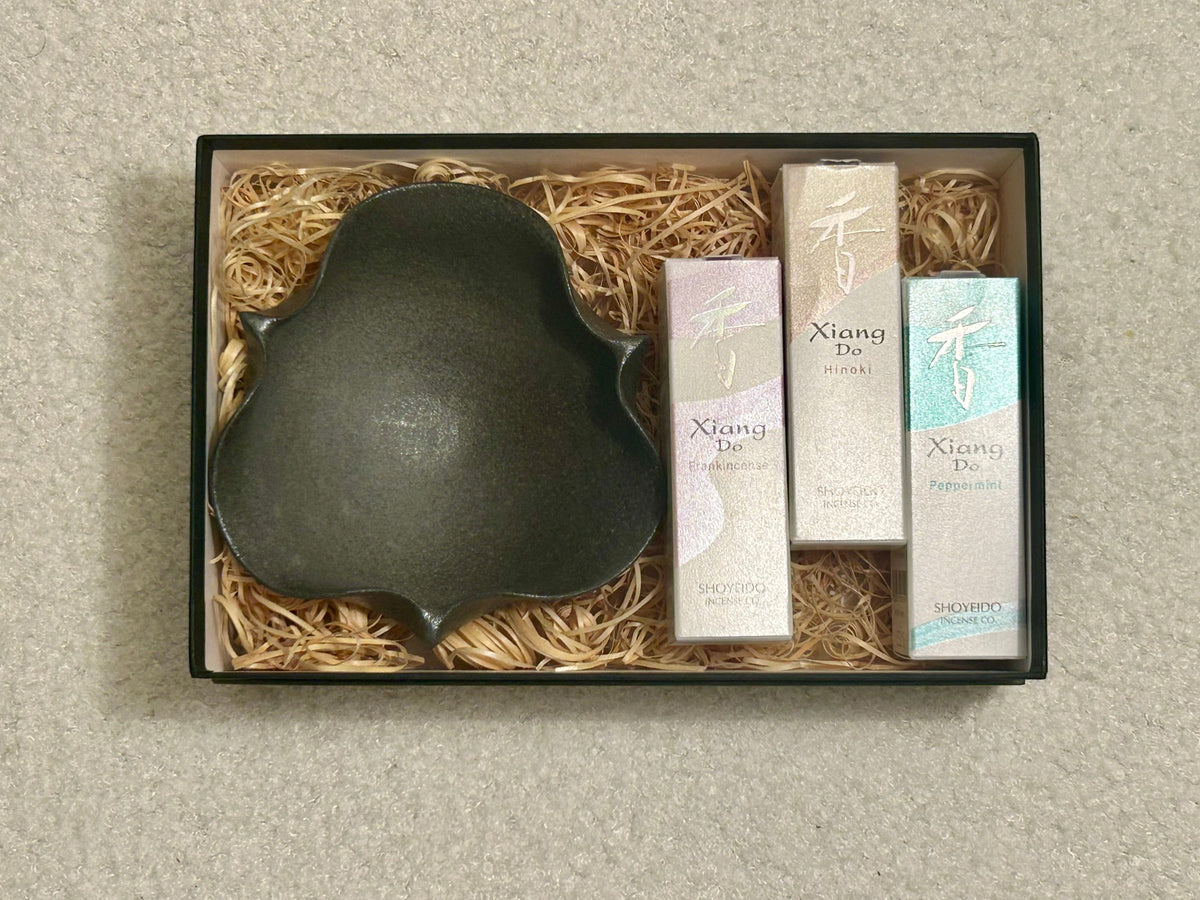
The Zen Complete Set pairs a hand-formed Suzu-yaki incense plate by Takanori Kizawa with Frankincense, Hinoki, and Peppermint Xiang Do incense. It is a quiet daily object from the same peninsula that makes salt by sea, sand, sun, and fire. Explore Gift Sets for a considered Noto craft gift. Ships worldwide.