Japanese auspicious patterns, or kisshō monyō (吉祥文様), are decorative motifs that carry wishes for peace, longevity, growth, harmony, and prosperity. They are not a single fixed vocabulary with one universal interpretation. Their meanings developed through images, word associations, Buddhist and courtly culture, textiles, ceramics, gifts, and everyday life. To read them well is to notice both the pattern and the wish attached to it.
Five motifs are especially useful for understanding this language: seigaiha (青海波), the blue ocean waves; karakusa (唐草), the winding vine; kikkō (亀甲), the tortoiseshell hexagon; shippo or shippō (七宝), the overlapping circles; and asanoha (麻の葉), the hemp leaf. Each has a distinctive visual rhythm. Each also offers a different way to think about a gift meant to be used, rather than simply displayed.

What Does “Auspicious Pattern” Mean?
“Auspicious” means favourable or promising. In Japanese craft, an auspicious motif can turn an object into a quiet message: may your home be peaceful; may your relationships remain connected; may your children grow strongly; may your life be long. The motif does not guarantee an outcome. It gives a human intention a visible form.
This is why Japanese patterns often feel natural on gifts. A pattern can say something specific without requiring a long explanation. It can mark a wedding, a new home, a birth, a new venture, a seasonal celebration, or simply the decision to give an ordinary day more care.
Pattern meanings also become clearer when you look at the structure of the image. Waves repeat, vines extend, circles overlap, hexagons lock together, and leaves radiate from a centre. These are not only symbols attached to a surface. They are small visual systems. Their movement and balance affect how the object feels in the room, even before the viewer knows the name.
That makes kisshō monyō useful for contemporary design. A motif can carry history without requiring a room to look historic. On a dark handmade vessel, a pressed pattern can remain quiet at a distance and become legible only when the object is held close.
The word monyō refers to a pattern or decorative design. Kisshō monyō is therefore best understood as a family of favourable motifs, not as a rigid list. A design may be admired for its geometry first and understood through its associations later.
1. Seigaiha: Waves That Continue
Seigaiha (青海波) is built from repeated fan-shaped waves. The name is commonly translated as “blue sea waves.” Nippon.com notes that the name is also associated with the gagaku court dance called seigaiha, and that the motif appears in a scene from The Tale of Genji.
The pattern’s emotional force comes from repetition. One wave becomes a field of waves. The sea does not end at a single crest, so the design naturally lends itself to wishes for an unbroken peaceful life and a future that continues beyond the present moment. It can feel calm without being static. The lines move forward while the overall pattern remains composed.
Seigaiha is an especially fitting motif for a gift connected to home. It can express a wish for steady days, a gentle household, or a life that keeps opening outward. It also carries a quiet connection to coastal places. For a brand rooted in Suzu City and the Noto Peninsula, that relationship with the sea is felt rather than forced: the pattern’s curves can sit beside the memory of a coastline without pretending to depict one particular shore.
Gift language: Calm seas, without end.
Shop the Seigaiha mini holder →
2. Karakusa: Growth That Keeps Reaching
Karakusa (唐草) is a winding plant or arabesque motif. Stems curl, leaves appear, and the line extends in several directions. Nippon.com describes the vines as symbols of longevity and prosperity, while also noting that the pattern entered Japan through Silk Road exchange. That history matters: Japanese patterns are not sealed inside a single national origin story. They often show how ideas travelled, were adapted, and became local through use.
Karakusa’s meaning is carried by the behaviour of the vine. It does not grow as a rigid vertical line. It bends, loops, fills space, and continues. The motif can therefore suggest vitality and continuity, but also generosity: growth that makes room for more growth. On a small object, the repeated line gives the surface movement without making it busy.
As a gift, karakusa suits a housewarming, a new business, a new chapter, or anyone whose life is entering a period of expansion. It is warm without being overly literal. The pattern does not need to be explained as “success.” Its reaching lines already communicate a sense of life in motion.
Gift language: Growth that keeps reaching.
Shop the Karakusa mini holder →
3. Kikkō: The Strength of a Long Life
Kikkō (亀甲) is a hexagonal pattern based on the shape of a tortoiseshell. The tortoise has long been associated with longevity in East Asian visual culture, and the hexagon’s tessellated structure gives the motif both symbolic and architectural strength. Nippon.com identifies kikkō as an auspicious pattern representing long life.
There is a useful difference between the image and the grid. The tortoiseshell gives the motif its association with age and endurance; the repeated hexagons make the design feel ordered and protective. One cell touches another. The surface becomes a network rather than a collection of isolated marks.
Kikkō can make a thoughtful gift for a milestone birthday, an anniversary, a retirement, or a person whose presence has become a form of stability for others. It can also be read more simply: a wish that something well made will remain useful for a long time.
That last reading connects naturally with handmade pottery. A vessel is not valuable only because it is old. It becomes meaningful through repeated use. A small incense holder may begin as a beautiful object and become, over time, the place where an evening starts.
Gift language: A long life, held with strength.
4. Shippo: Circles of Connection
Shippo or shippō (七宝) is made from overlapping circles. The intersections create a continuous network of rounded forms, sometimes with a star-like shape at the centre of each opening. The name means “seven treasures.” Nippon.com describes the pattern as auspicious for the prosperity of descendants, good relationships, and harmony.
Shippo is often explained through connection. Each circle overlaps another, so the design has no obvious isolated beginning or end. That makes it an appealing pattern for relationships, friendship, family, and shared life. The circles are equal in importance, but not identical in position. Together they create something larger than any one ring.
It is worth keeping the meaning precise. Shippo does not promise that every relationship will be easy or permanent. It expresses a wish for good ties and harmonious connection. On a gift, that distinction makes the pattern more sincere. It honours the relationship without pretending to control it.
Shippo is especially natural for weddings, anniversaries, housewarmings, and gifts between people who want to acknowledge an enduring bond. It also works for a personal object because “connection” can include a connection to a daily practice, a place, or a material tradition.
Gift language: Circles that meet in harmony.
5. Asanoha: Straight, Strong Growth
Asanoha (麻の葉) is a geometric pattern based on the leaves of the hemp plant. Its six-pointed forms create a crisp star-like structure. Nippon.com explains that hemp’s vigorous growth and resilience led to the pattern’s use on children’s clothing with the hope that they would grow big and strong.
Asanoha’s visual character is direct. The lines radiate from a centre and repeat with a clear internal logic. It feels energetic without being ornamental. The motif’s association with growth is therefore supported by both the plant and the geometry: a living form that rises quickly, and a structure that seems to extend in every direction.
In modern gifting, asanoha can be offered for a birth, a baby shower, a graduation, a new job, or any beginning that calls for encouragement. The traditional association with healthy growth should be understood as a cultural wish, not a medical claim. The design says: may you develop with strength and clarity.
Gift language: Grow straight, grow strong.
Shop the Asanoha mini holder →
Patterns Are Wishes, Not Guarantees
It is tempting to translate every motif into a single English word and stop there. That makes a complicated visual culture easy to scan, but it can also make the designs sound like lucky charms with guaranteed results. A more respectful reading is modest. The pattern carries an intention that the giver and receiver may recognise, adapt, or simply enjoy.
The same motif can appear on a child’s clothing, a wedding gift, a textile, a family crest, or a household object. Context changes the emphasis. Asanoha may speak to growth in one setting and to crisp geometry in another. Shippo may express a relationship between people or simply give a surface a continuous rhythm. The pattern remains meaningful without needing to do only one job.
Why These Patterns Belong on a Small Daily Object
Auspicious patterns are often encountered on textiles, wrapping cloths, tableware, family crests, and architectural details. A small incense holder gives the language a different scale. The pattern is not across an entire garment or room. It sits close to the hand, the ash, and the few minutes of air after a match is extinguished.
This is where Suzu-yaki (珠洲焼) offers a strong material contrast. Suzu-yaki is an unglazed stoneware tradition from the Noto Peninsula. Its dark surface comes from clay, reduction firing, high heat, and wood ash rather than an applied black glaze. The material is restrained; the pattern can carry the message. Together, they allow a gift to be both quiet and intentional.
Read What Is Suzu-yaki? for the material background, or revisit Japanese Black Pottery, Explained for a closer look at why the charcoal surface is not painted or coated in the usual sense.
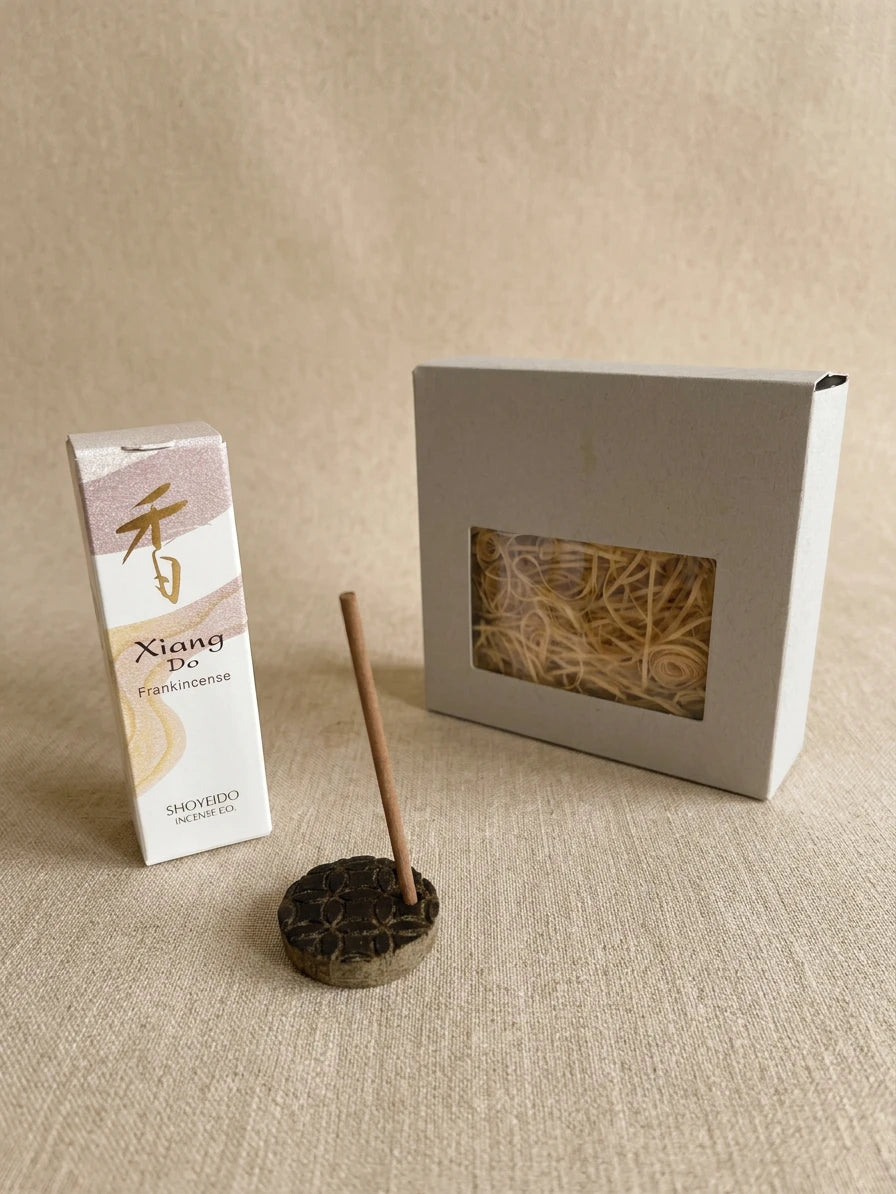
The five Kisshō Monyō incense holders are now available as a limited line — each pattern hand-pressed by Suzu-yaki potter Rie Orisaka as a single, one-of-a-kind piece. See the five mini holders, or the Mini Gift for a holder paired with a Shoyeido incense scent.
Choosing a Pattern as a Gift
Start with the person, not the pattern chart. Choose seigaiha for a wish of peace and a life that continues steadily. Choose karakusa for growth, vitality, or a new venture. Choose kikkō for longevity and enduring usefulness. Choose shippo for harmony and good ties. Choose asanoha for a beginning and the hope of strong development.
These meanings are invitations, not rules. A recipient may love seigaiha for its geometry, shippo for its rhythm, or kikkō simply because the hexagons suit the room. Cultural meaning adds a layer to the object; it does not cancel personal taste.

Give a Quiet Wish a Place in the Day
Choose from the five patterns above: the Kisshō Monyō mini holders — “The Fortunes”, each a single hand-pressed piece by Suzu-yaki potter Rie Orisaka. For a holder and a Shoyeido incense scent together, see the Mini Gift. For a complete ritual with three scents and a full-size plate, see the Zen Complete Set. Ships worldwide.
Sources and further reading: Nippon.com, Traditional Japanese Patterns and Meanings; Musubi Kiln, 7 Lucky Japanese Patterns; The Zen Artisan, What Is Suzu-yaki?. Cultural and product information checked November 12, 2026.

