Ensō circle meaning is not one fixed definition. In Zen Buddhist art, the ensō (円相) is a circle made with a single brushstroke, and museums describe it through several possible ideas: completeness, emptiness, the cycles of existence, and the character of the person who painted it. Its power comes partly from that openness. The circle can be recognised immediately without being reduced to one slogan.

What is an ensō?
The Japanese word ensō means “circle.” In the context of Zen calligraphy, it usually refers to a circle painted in one continuous brush movement, often with ink on paper. The Asian Art Museum traces the motif to early Chinese Chan sources, where Zen Buddhist masters are recorded as drawing circles while teaching. From there, the form became part of a long history of Japanese Buddhist painting and calligraphy.
That history matters because the ensō is not simply a minimalist icon. A brush circle can be a work of religious art, a teaching image, a personal act of concentration, or a calligraphic statement accompanied by an inscription. Its meaning depends on the maker, the words, the setting, and the viewer’s encounter with it.
Completeness—and the space inside
The circle naturally suggests wholeness. The Asian Art Museum describes its completeness as a possible symbol of enlightenment and its unbroken shape as a reminder of continuity. At the same time, the empty centre can be associated with śūnyatā, or emptiness, a fundamental Buddhist idea. These meanings are not necessarily opposites. A full form can make an open centre visible; a boundary can give space its shape.
It is better to say “possible meanings” than to assign the ensō a single universal translation. Museum collections include circles accompanied by different phrases, including words that connect Zen practice to ordinary tea and food. The image can point beyond everyday life, but it can also return attention to the cup in front of you.
Why no two brush circles look alike
An ensō is usually painted in one stroke, but “one stroke” does not mean “perfectly uniform.” The line may be thick or thin, open or closed, forceful or restrained. The Asian Art Museum notes that variations are traditionally thought to reveal something about the painter’s state of mind and character. That does not turn the painting into a psychological test. It acknowledges that gesture leaves a record.
This is where the popular phrase “completeness and imperfection” becomes useful, provided it is not treated as a promise. The circle is complete as an action: the brush moved, the ink settled, and the work was allowed to remain as it was. It may also be irregular because a human hand is not a compass. The value is not in making an imperfect circle on command; it is in seeing how much information a simple form can hold.
Ensō, ma, and the pause around an object
The ensō connects naturally with ma (間), the Japanese idea of meaningful interval or space. A line becomes legible because of the paper around it. A circle’s centre is visible because the ink establishes a boundary. In The Philosophy of Ma, we look at how unfilled space can give a vessel, flower, or room its presence.
A similar lesson appears in What a Zen Garden Teaches About Empty Space. A dry landscape garden is not just a collection of rocks; its open gravel field makes relationships and viewpoints visible. In both cases, restraint is compositional rather than merely decorative.
A respectful way to bring the idea home
You do not need to paint an ensō, call yourself a Zen practitioner, or turn a religious image into a lifestyle accessory. A more grounded response is to make one ordinary action less crowded. Clear a small surface. Use one vessel. Light one stick of incense safely, with ventilation and attention, then let the ritual end rather than filling the space with more activity.
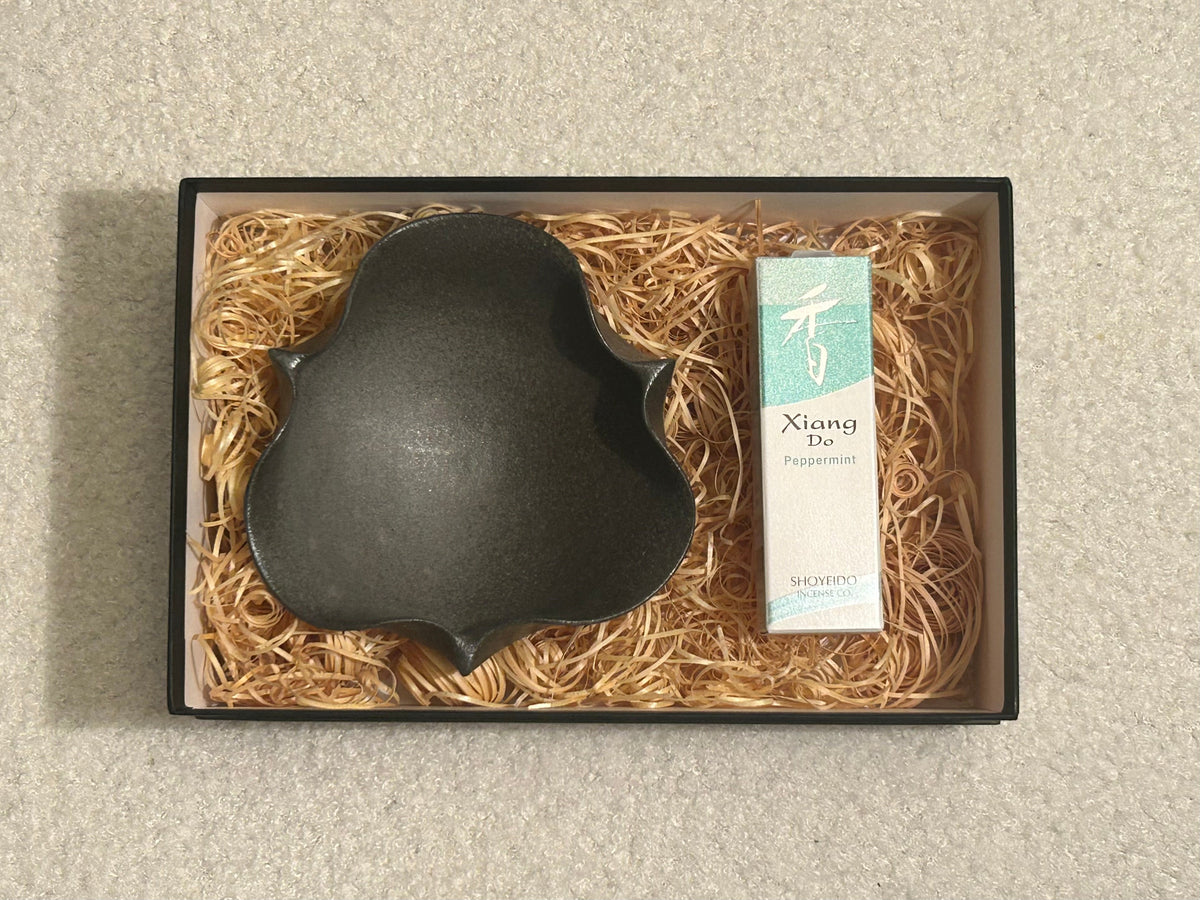
The Suzu-yaki Japanese Incense Starter Set offers one hand-formed plate from Noto and one chosen Xiang Do scent. It is not an ensō, and it does not reproduce a Buddhist artwork. It is simply a real, useful object that can help define a small beginning and a small ending in the day.
The circle as a practice of attention
The most lasting ensō circle meaning may be the one that resists being finalised. It can hold completeness and openness, discipline and variation, the mark of a person and the quiet of the paper around it. In a home, that does not require grand interpretation. It can mean leaving enough room to see the object you chose, use it properly, and stop before the moment becomes crowded.
For more material context, visit What Is Suzu-yaki? The page explains the unglazed Noto stoneware used in the incense plate, while the ensō reminds us that a simple form can carry history without needing to dominate a room.

Build a Zen corner in your day
Begin with the Suzu-yaki Japanese Incense Starter Set, or explore The Zen Artisan Gift Sets for a wider choice of handmade Suzu-yaki and Japanese incense. Keep the arrangement modest, useful, and your own. Ships worldwide.


