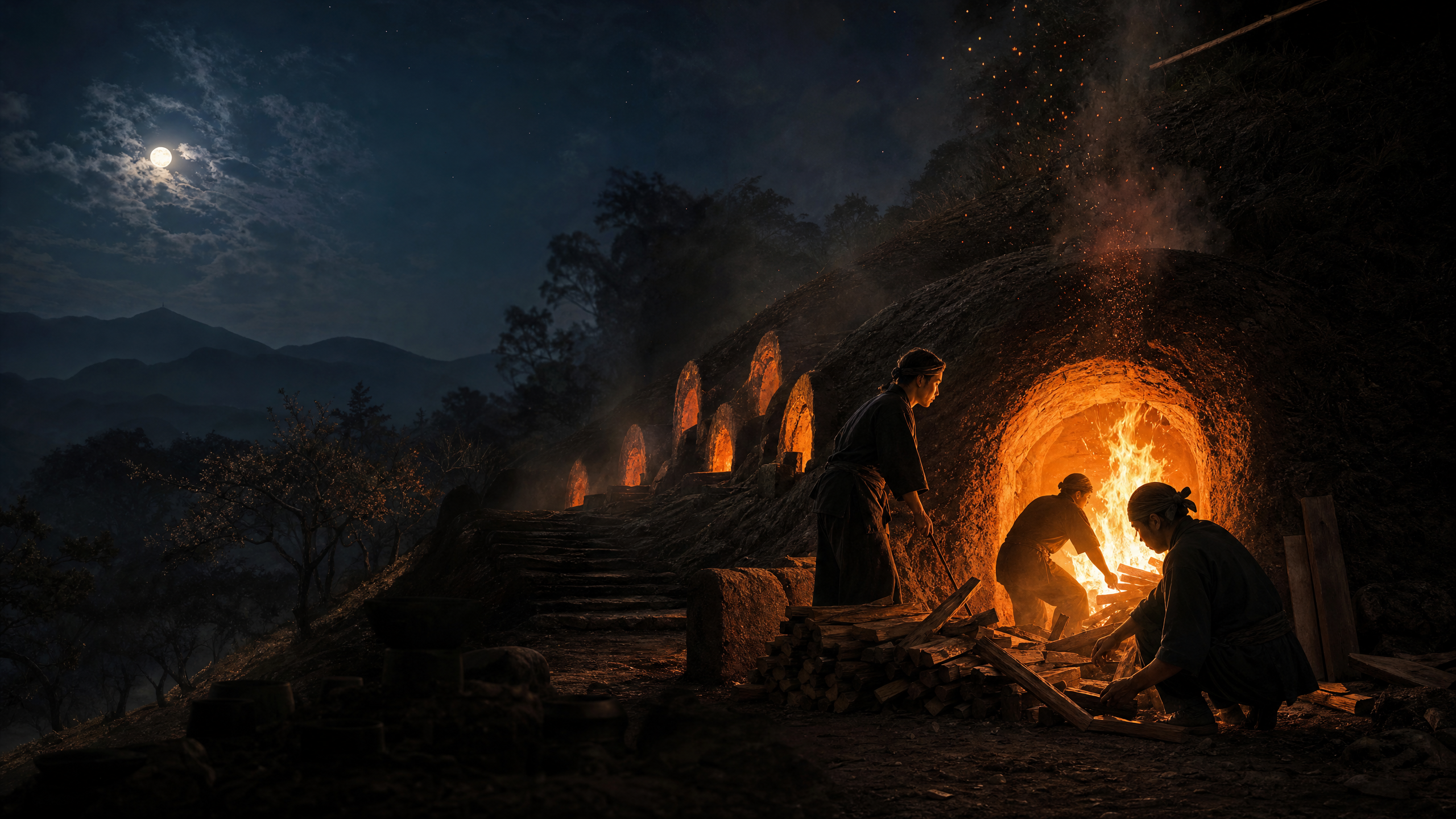

Before dawn, the kiln is still quiet. The vessels have already been formed, dried, and placed with extraordinary care inside the sloping chamber. Wood is stacked in disciplined rows. The potters move with the concentration of people preparing not for a single task, but for a vigil. A 72-hour anagama firing is not a mechanical step in production. It is a ceremony of endurance, judgment, and trust.
The word anagama means “cave kiln.” In its oldest form, it is a single-chamber tunnel kiln built into a slope, with the fire at one end and the flue at the other. This ancient technology reached Japan through Korean ceramic knowledge around the fifth century, and it became one of the defining engines of early Japanese stoneware. In Suzu, on the Noto Peninsula, medieval potters used tunnel-shaped kilns built into hillsides, firing unglazed vessels at temperatures above 1,100°C. The result was the austere black, blue-grey, and grey-black surface that makes Suzu-yaki feel less like decoration than geology.
The kiln is both instrument and collaborator.
A potter can prepare, place, and stoke, but the final surface is born from fire, ash, oxygen, minerals, and chance.
Loading the Chamber
The firing begins long before the first flame. Loading an anagama is a form of three-dimensional composition. Pieces nearer the firebox may be struck by heavier ash and fiercer heat. Vessels deeper inside the kiln may receive a gentler touch, with softer flashing, quieter ash marks, and subtler tonal shifts. Every cup, jar, bowl, and vase is placed with an imagined path of flame in mind.

AI-generated image: vessels arranged inside a tunnel kiln before the long firing begins.
This stage explains why wood-fired ceramics feel so alive. No two positions in the kiln are truly identical. The flame does not move like a diagram; it searches, curls, accelerates, and pauses. It carries ash. It changes direction around shoulders and rims. In this sense, the potter is not simply making an object. The potter is arranging conditions for a future encounter between clay and fire.
The First Day: Warming the Clay
The early hours are patient. The kiln must be warmed gradually so moisture leaves the clay and kiln walls without shock. Too fast, and a vessel may crack before the true firing even begins. The flame is fed carefully, almost politely. Smoke moves through the chamber. The kiln begins to breathe.
As the temperature rises, the atmosphere inside the kiln becomes increasingly complex. Burning wood produces heat, but also ash and volatile salts. These particles travel with the flame, settling on the ware. In many modern kilns, glaze is applied before firing. In an anagama, the kiln itself becomes the source of glaze. Ash lands on the clay, melts at high temperature, and forms a natural sheen that can appear pale grey, silver, olive, or muted gold depending on position, temperature, and atmosphere.
The Second Day: Fire Without Pause
By the second day, the firing has become a relay. Someone must watch the fire at every hour. Wood is consumed quickly in the heat, and stoking continues through daylight, midnight, and the thin blue hours before morning. The work is physical, but the decisions are subtle. How much wood? How often? Should the fire be urged forward or held steady? Should the kiln be given more air, or starved of oxygen?
For Suzu-yaki, this question of oxygen is central. When the kiln is sealed or deprived of oxygen near the end of firing, iron contained in the clay can undergo reduction, producing the dark, dignified tones associated with Suzu ware. The black is not a coating. It is a transformation within the clay body itself, a color made by atmosphere and mineral memory.
The Third Day: Ash, Reduction, and Surrender
The final day is the most intense. The kiln has reached its full voice. Heat presses outward from the firebox. Embers collapse and are renewed. The potters read color through openings, listen to draft, and respond to the changing appetite of the kiln. A 72-hour firing is long enough for surfaces to mature, for ash to gather, and for flame to leave a record of its movement.

AI-generated image: an imagined close view of ash, flame marks, and blackened clay surface.
Then comes the paradox: after three days of relentless action, the potter must stop. The kiln is sealed. Heat remains, but the firing is over. Cooling may take days, and during that silence the wares continue to settle into their final state. The kiln cannot be opened too soon. Anticipation must become discipline.
Why This Matters
To hold a wood-fired Suzu-yaki piece is to hold evidence of time. The marks are not printed, sprayed, or repeated by formula. They are the visible remains of a living process: where ash fell, where flame struck, where oxygen disappeared, where minerals darkened, where heat was most severe and where it softened.
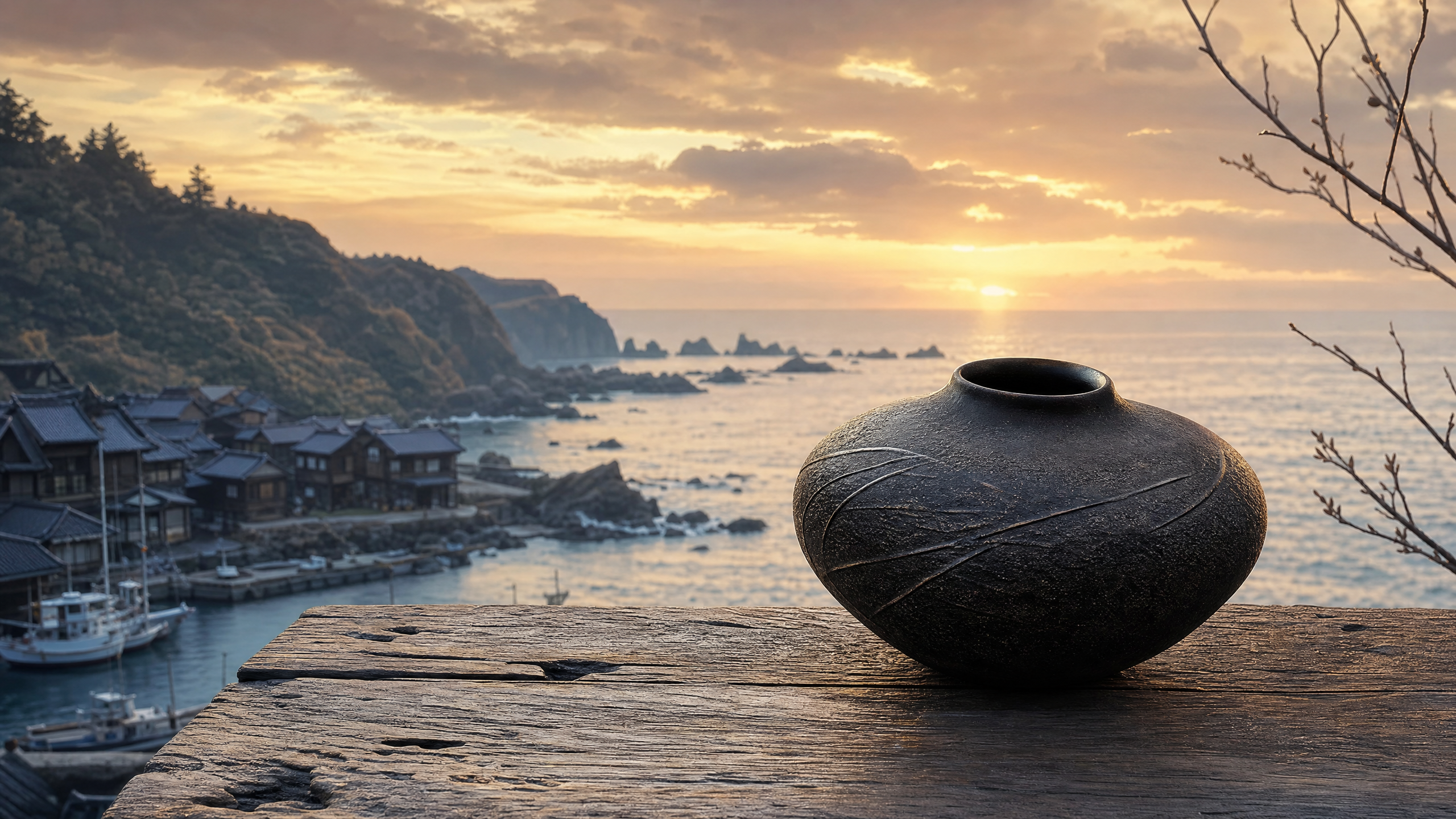
This is why the surface of Suzu-yaki carries such quiet authority. Its beauty does not announce itself with bright glaze or ornament. It asks for attention. A rim may reveal a silvered trace of ash. A shoulder may hold a smoky blue-grey bloom. A foot may remain matte and earthen, grounding the vessel in the soil from which it came.
The 72-hour anagama firing is more than a technique. It is a relationship with uncertainty. The potter prepares everything, then gives the work to fire. In that surrender, Suzu-yaki becomes what it has always been: clay shaped by human hands, completed by nature, and made permanent by flame.
Sources consulted: Art Research Center, Ritsumeikan University, “Suzu Ware” via Google Arts & Culture; JapanGov, “Keeping the Flame of Suzu's Kilns Alive”; and reference material on anagama kiln structure and firing characteristics.
All article images are AI-generated editorial illustrations and are not photographs of real Suzu-yaki pottery.