Reading the Clay: How to Identify Authentic Suzu-yaki
A collector’s guide to the quiet signs of iron-rich clay, reduction firing, natural ash, and the human hand.

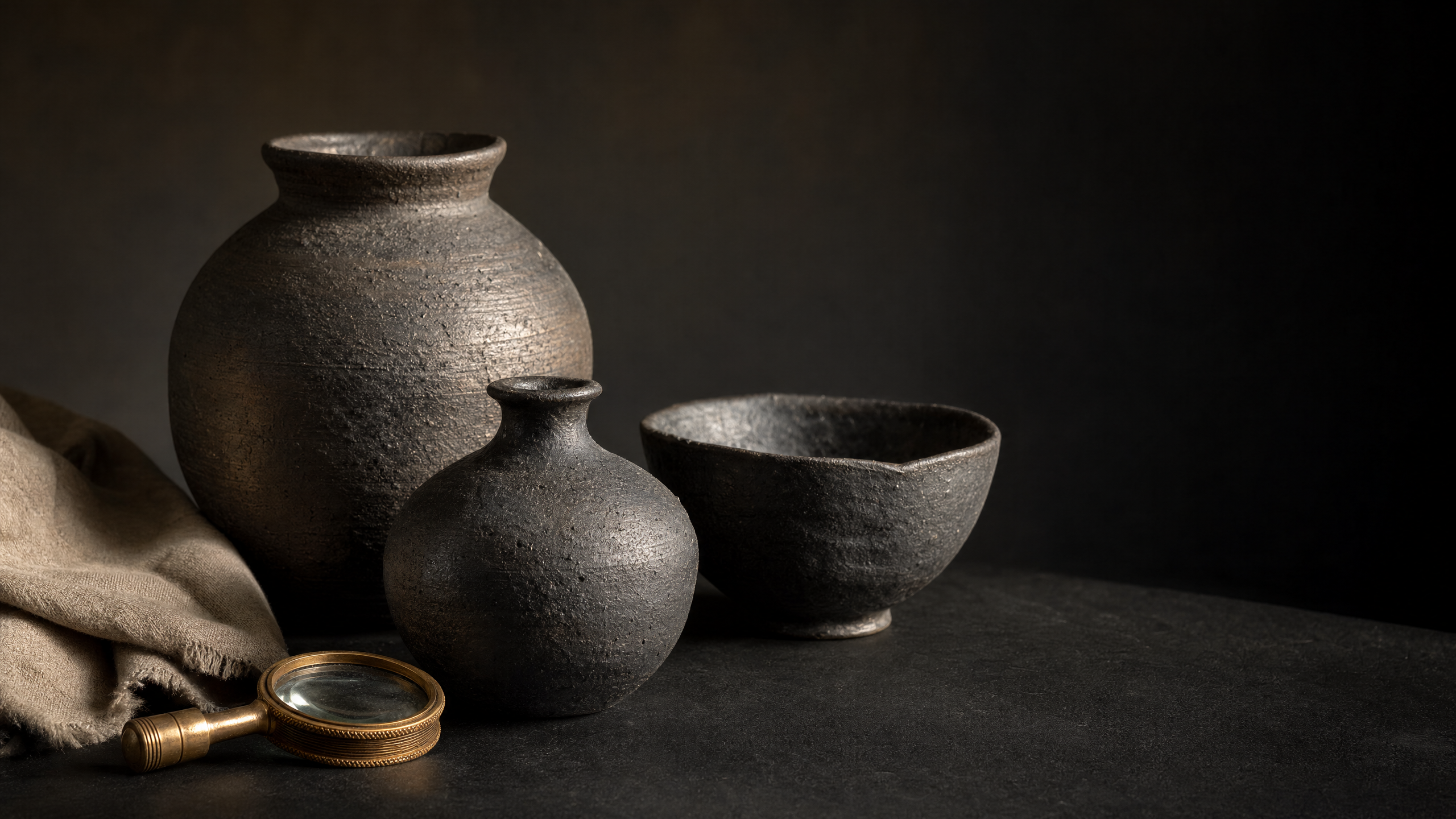
AI-generated editorial image inspired by Suzu-yaki; not a photograph of an actual Suzu-yaki work.
To understand Suzu-yaki, begin not with ornament, but with restraint. Authentic Suzu ware asks the eye to slow down. Its surface is dark, quiet, and often almost lunar: charcoal gray, bluish black, or ash-softened silver. It does not declare itself through painted decoration or a glossy applied glaze. Instead, it reveals a story of local clay, wood fire, oxygen-starved heat, and the measured force of the potter’s hand.
Historically, Suzu ware emerged in the twelfth century at the tip of the Noto Peninsula, a coastal region whose position on the Sea of Japan made it ideal for moving heavy ceramics by ship.1 Suzu City’s museum overview describes it as an unglazed pottery made from iron-rich local clay, produced from the mid-twelfth to late fifteenth centuries before disappearing for centuries.2 For today’s collector, that history gives us a practical question: when a piece is called Suzu-yaki, what should we actually look for?
1. Look for Darkness With Depth
The first sign is color, but not merely “black.” Suzu-yaki is shaped by reduction firing, a process in which the kiln is deprived of oxygen. In traditional firing, anagama kilns were sealed after the fire was extinguished, causing iron in the clay to reduce and turn the surface bluish gray or grayish black.1 Ishikawa’s traditional craft museum similarly notes that Suzu’s iron-rich soil and high-temperature firing produce its charcoal-gray character.3
This means authentic Suzu-yaki should rarely feel like a flat, industrial black coating. The best surfaces have movement: smoky gray passages, darker hollows, pale ash flecks, and warm undertones where fire has touched the form differently. A uniform, slick, paint-like black should invite careful questioning.

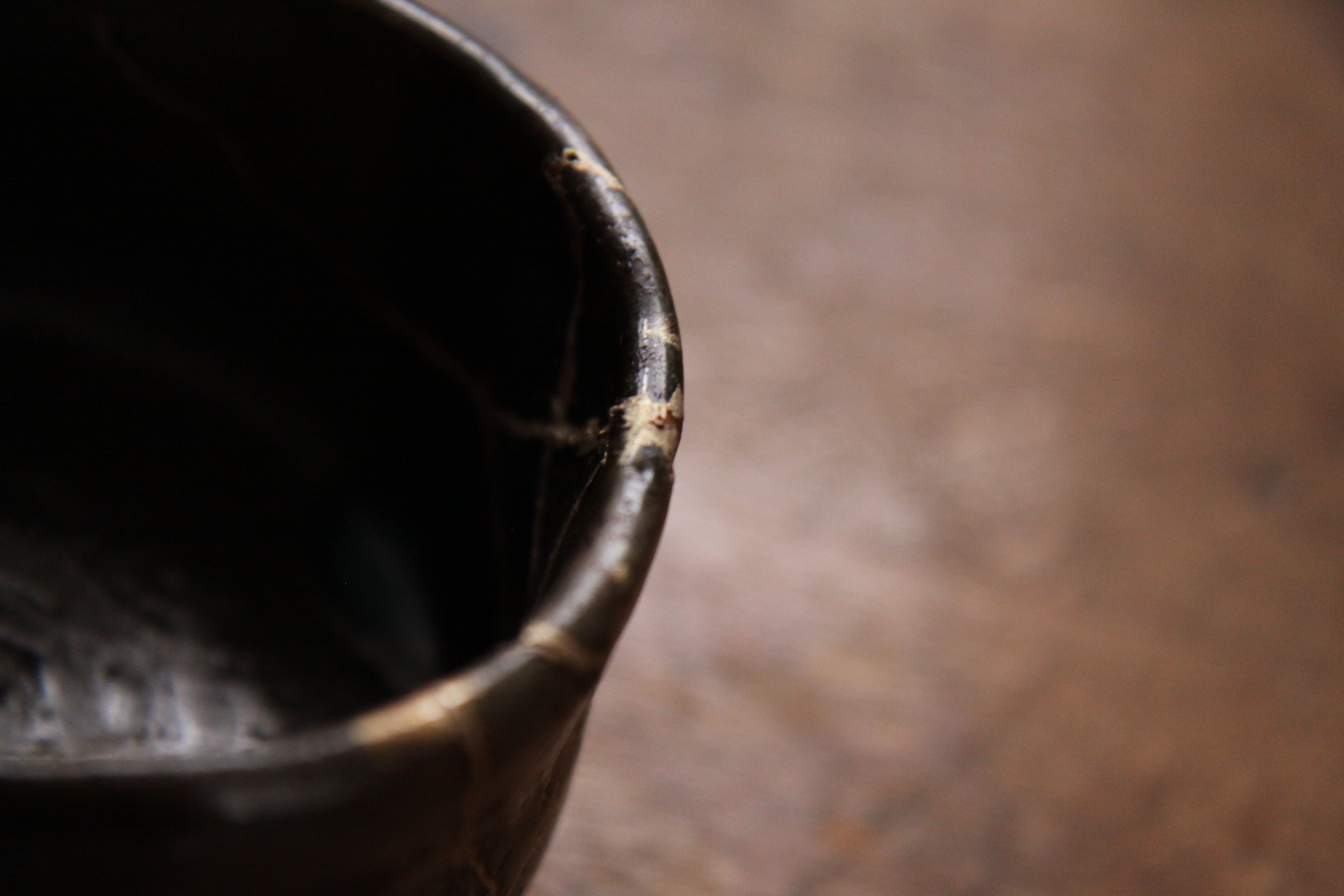
AI-generated close-up illustrating granular clay texture and natural ash effects.
2. Understand the Difference Between No Glaze and Natural Ash
A common misunderstanding is that unglazed means visually plain. Suzu-yaki uses no applied glaze, yet wood ash in the kiln can melt onto the surface, creating a subtle natural glaze or sheen.1 The Smithsonian’s description of a fourteenth-century Suzu storage jar records “no” glaze, while also noting light wood-ash effects and whitish specks where the clay surface was protected from reduction.4
For the collector, this distinction is essential. An authentic Suzu-yaki surface may glimmer, but it should not look like a deliberately applied glassy glaze. The beauty lies in accident disciplined by fire: ash landing on shoulders, melting softly, and leaving a trace of the kiln’s atmosphere.
3. Read the Hand in the Surface
Suzu ware is not only a color; it is a method of making. Historic vessels were formed from coils of clay and shaped with beating, smoothing, and paddle-and-anvil techniques.2 The Smithsonian jar, for example, was formed by coiling and throwing, then finished with a paddle carved with parallel grooves, leaving a striated surface from neck to base.4
On authentic or faithfully revived pieces, look for evidence of touch rather than mechanical perfection. There may be faint paddle marks, hand-smoothed transitions, asymmetry around the lip, or a quiet irregularity in the foot. These signs are not flaws. They are the record of clay being persuaded into form.
| Feature | What to Notice | Why It Matters |
|---|---|---|
| Color | Charcoal gray, bluish gray, gray-black variation | Signals iron-rich clay and reduction firing |
| Surface | Unglazed body with subtle ash sheen | Distinguishes natural kiln effects from applied glaze |
| Texture | Granular clay, sand, small inclusions, tactile roughness | Reflects local clay character and hand-built presence |
| Forming Marks | Paddle marks, striations, combed lines, incisions | Connects the object to Suzu’s forming traditions |
4. Feel for Earth, Not Gloss
The MOA Museum of Art describes a medieval Suzu jar as having high sand content in the clay, creating texture, with a dark ash unglazed surface formed through reduction firing.5 In the hand, Suzu-yaki should feel grounded. Even when refined, it carries a mineral density and tactile honesty that differs from porcelain smoothness or glossy glazed stoneware.
A piece may be elegant, but it should not feel anonymous. The surface should invite touch: a slight drag under the fingers, a dry warmth, a granular liveliness. This physical quality is one of the reasons Suzu-yaki feels so at home in rituals of tea, sake, coffee, and quiet dining.

AI-generated kiln scene evoking wood firing and reduction atmosphere.
5. Ask for Provenance, Maker, and Method
Visual reading is powerful, but it is not enough. Because contemporary Suzu-yaki is a revived tradition, authenticity should also be supported by provenance: the potter’s name, studio location, firing method, clay source when available, and seller documentation. Suzu City notes that the ware was rediscovered after a 1951 excavation, revived through experiments by Onodera Gen beginning in 1972, and is now made by potters on the Noto Peninsula.2 Ishikawa’s traditional craft museum identifies the modern revival as beginning in 1976.3
For antique works, authentication belongs to specialists and institutions. For contemporary works, the best confidence comes from transparent sourcing and a maker who understands the lineage. A trustworthy seller should be able to explain not only what the piece is, but how it was made and why it belongs within the Suzu-yaki tradition.
The Quiet Confidence of Authentic Craft
To read Suzu-yaki is to read the meeting of earth and fire. The dark surface is not decoration added afterward; it is the visible result of iron, ash, oxygen, and time. The marks are not manufactured nostalgia; they are traces of forming, firing, and risk. Authentic Suzu-yaki does not need to shout. It rewards the attentive collector with depth, tactility, and permanence.
When choosing a piece, look closely. Turn it in the light. Notice the ash. Feel the clay. Ask about the maker. In that slow encounter, the vessel begins to speak—not as an object of fashion, but as a continuation of a thousand-year conversation between the Noto Peninsula and fire.
References
1. Art Research Center, Ritsumeikan University, “Suzu Ware,” Google Arts & Culture. Source
2. Suzu City, “Suzu Ware Museum Overview.” Source
3. Ishikawa Prefectural Museum of Traditional Arts and Crafts, “Suzu Pottery.” Source
4. Smithsonian National Museum of Asian Art, “Suzu ware storage jar.” Source
5. MOA Museum of Art, “Textured Suzu ware tsubo jar.” Source