Sue Ware: The Korean Ancestor of Suzu-yaki
When we hold a piece of Suzu-yaki pottery, we are not merely touching a vessel crafted in modern Japan. We are holding a physical connection to a lineage that stretches back over a millennium, crossing oceans and bridging cultures. To truly understand the profound, dark beauty of Suzu-yaki, we must look back to its ancient ancestor: Sue ware (須恵器, sueki), a revolutionary ceramic tradition born on the Korean peninsula.
The Arrival of the Toraijin
Before the 5th century, Japanese pottery consisted primarily of Haji ware—porous, reddish earthenware fired at relatively low temperatures in open bonfires. While functional, these vessels lacked the durability and refinement required for long-term storage or elite ceremonial use.
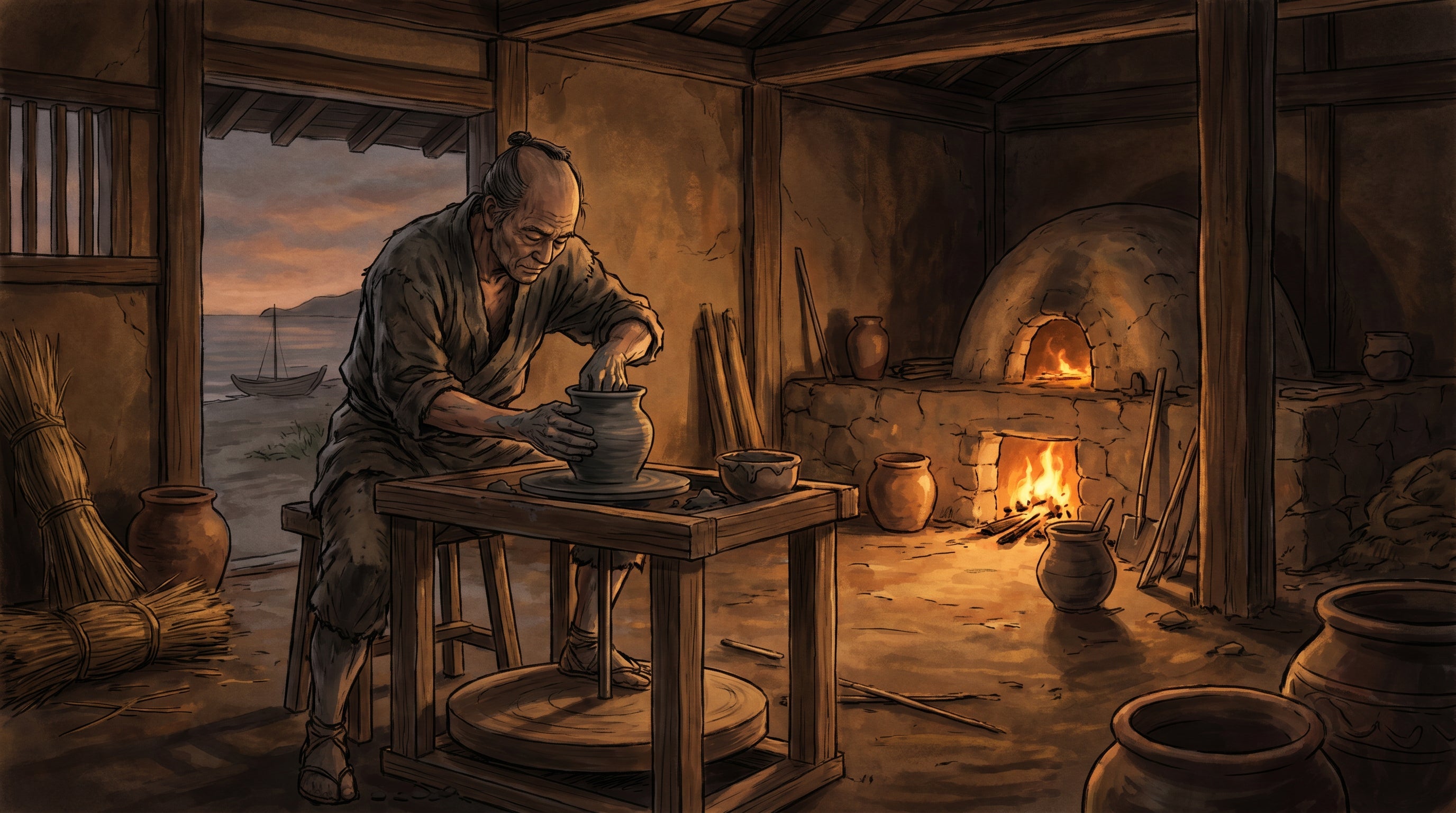
This changed dramatically during the Kofun period (c. 300–538 CE) with the arrival of the Toraijin (渡来人), immigrant craftsmen from the Asian continent. Many of these skilled artisans hailed from the Gaya confederacy in southern Korea. They brought with them advanced technologies that would forever alter the trajectory of Japanese ceramics: the potter's wheel and the anagama (tunnel) kiln.

The Toraijin artisans introduced the potter's wheel and advanced kiln technology to Japan.
The Technology of Fire and Earth
The pottery produced by these immigrant craftsmen became known as Sue ware. The term "Sue" (須恵) was coined in the 1930s by archaeologist Shuichi Goto, drawing from references in the ancient Japanese poetry anthology, the Man'yōshū. Previously, it was often simply called Chōsen doki, meaning "Korean pottery."
What made Sue ware revolutionary was its firing process. The Toraijin built anagama kilns—long, tunnel-like structures dug into the slopes of hills. These kilns could reach extreme temperatures exceeding 1,000°C (1,832°F). More importantly, the artisans mastered the technique of reduction firing. By sealing the kiln at the peak of the firing process, they starved the fire of oxygen. The flames, desperate for fuel, pulled oxygen molecules directly from the iron-rich clay itself.
This chemical transformation turned the clay into a dense, non-porous stoneware with a striking dark blue-gray or charcoal-white color. Though generally unglazed, the intense heat often caused wood ash to melt and fuse with the clay surface, creating beautiful, accidental natural ash glazes (shizen-yū).

The Noto Peninsula's Senmaida (千枚田) rice terraces — the ancient landscape where the legacy of Sue ware, carried across the sea by the Toraijin, evolved into the Suzu-yaki tradition. Photo: © ほっと石川旅ねっと
From Elite Rituals to Everyday Life
Initially, Sue ware was a luxury item. Its production was tightly controlled, and the vessels were primarily used for elite rituals, ceremonial offerings, and as grave goods buried in the massive kofun (tumulus) tombs of the ruling class. The sophisticated forms included footed cups, long-necked flasks, and elaborate vessel stands.
As centuries passed, the technology spread. By the Nara (710–794 CE) and Heian (794–1185 CE) periods, Sue ware kilns were established across Japan, from southern Osaka to the Inland Sea and eastern Honshū. The pottery transitioned from exclusive ritual objects to utilitarian wares used in daily life, including the production of roof tiles for the provincial temple system.
The Birth of Suzu-yaki
By the end of the Heian period in the 12th century, the original Sue ware tradition began to evolve into distinct regional styles. It is here, on the rugged Noto Peninsula, that the story of Suzu-yaki begins.
Suzu-yaki is a direct continuation of the ancient Sue ware lineage. The artisans of Suzu inherited the anagama kiln technology and the reduction firing techniques brought over by the Toraijin centuries earlier. Using the unique, iron-rich clay of the Noto Peninsula, they fired their vessels at over 1,200°C, starving the kiln of oxygen to produce the signature deep, lustrous black stoneware that defines Suzu-yaki.

The Noto Peninsula's coastline on the Sea of Japan — the same waters that the Toraijin (渡来人) crossed in the 5th century, bringing with them the ceramic knowledge that would become Suzu-yaki. Photo: © ほっと石川旅ねっと
While Suzu-yaki flourished during the Muromachi period, becoming a vital trade good along the Sea of Japan, it mysteriously vanished in the late 15th century. For 400 years, this "phantom pottery" lay dormant, much like the ancient Sue ware buried in the kofun tombs.
A Living Legacy
Today, following its miraculous revival in 1976, Suzu-yaki stands as a testament to the enduring power of traditional craftsmanship. It is recognized as one of the descendants of Japan's ancient ceramic traditions, sharing its DNA with other famous styles like Bizen ware.
When you bring a piece of Suzu-yaki into your home, you are not just acquiring a beautiful object. You are participating in a story that began in the 5th century on the Korean peninsula—a story of immigrant artisans, roaring tunnel kilns, and the alchemy of earth and fire. The deep black surface of a Suzu-yaki vase or tea cup is the modern echo of ancient Sue ware, a silent, beautiful reminder of the shared history that shapes our world.